

[ad_1]
- The euro/the US dollar is declining to 1.1296 after Trump announced a sharp tariff for the European Union imports starting from June 1.
- The husband returns to 1.1350, where the US dollar remains compressed by high financial deficit concerns.
- The euro ignores the discussion of the prices of the European Central Bank, with the support of improving German GDP numbers.
Euro/dollars During the mid -northern American session on Friday after diving less than 1.1300, he recovered after US President Donald Trump shook the markets by threatening a 50 % tariff on the European Union (European Union). At the time of writing this report, the husband recovered and climbed to about 1.1350
US President Donald Trump posted on his social network early Friday that discussions with the European Union “do not go anywhere! Therefore, I recommend a 50 % initial tariff for the European Union, starting from June 1, 2025”, he wrote. The euro/the US dollar fell to 1,1296 on the notes before resuming the upward trend.
In the wake of these statements, US Treasury Secretary Scott Besin said that “the European Union’s proposals were not good,” adding that “most countries are negotiating in good faith, except for the European Union.”
Greenback remains on the back foot, as it weighs with the approval of the Trump Tax Bill in the House of Representatives, which is on its way to the Senate. If passed, the proposal will add approximately $ 4 trillion to the US debt ceiling for a decade, according to the CBO budget office.
It should be noted that the US dollar is still not aggressive for Federal Reserve Speakers (Fed), who have so far said that the American Treasury market is working in an organized manner, adding that uncertainty about supply, stock and inflation chains keeps the executives of business unprecedented for the future.
the American economic list American housing data appeared in May, which was mixed with low construction permits, but new homes sales were improved in April.
in The euro areaGerman GDP (GDP) improved annually, although it remained in shrinkage lands.
Meanwhile, euro I ignored speculation that European Central Bank (ECB) is expected to reduce interest rates at the next meeting. Ren and Stornaras from the European Central Bank prefer a reduction in interest in June, with the latter supporting the pause after that.
Daily market engine/US dollar: The euro prefers the direction of “selling America”
- The euro remains preferred by the weakness of the US dollar. The US dollar index (DXY), which tracks the performance of six currencies against the US dollar, decreased by 0.79 % in 99.10, its lowest level since April 29.
- “Sell America” continues with the sale of investors from American bonds, stocks and US dollars. The “trade war” of US President Donald Trump was released and lower Moody’s debts for American debts from AAA to AA1.
- The American table was characterized by construction permits, which decreased by 4 % of my mother in April, and decreased from 1.481 million to 1.422 million, indicating a slowdown in future construction activity.
- New homes sales increased by 10.9 % of my mother, increasing from 0.67 million to 0.743 million, according to the American Statistical Office. This reflects the strong demand in the housing market despite the most strict supply conditions.
- Germany’s economy grew in the first quarter of 2025, as it exceeded the estimates of exports and carried the front industry before the American definitions. GDP (GDP) improves from 0.2 % to 0.4 % QOQ.
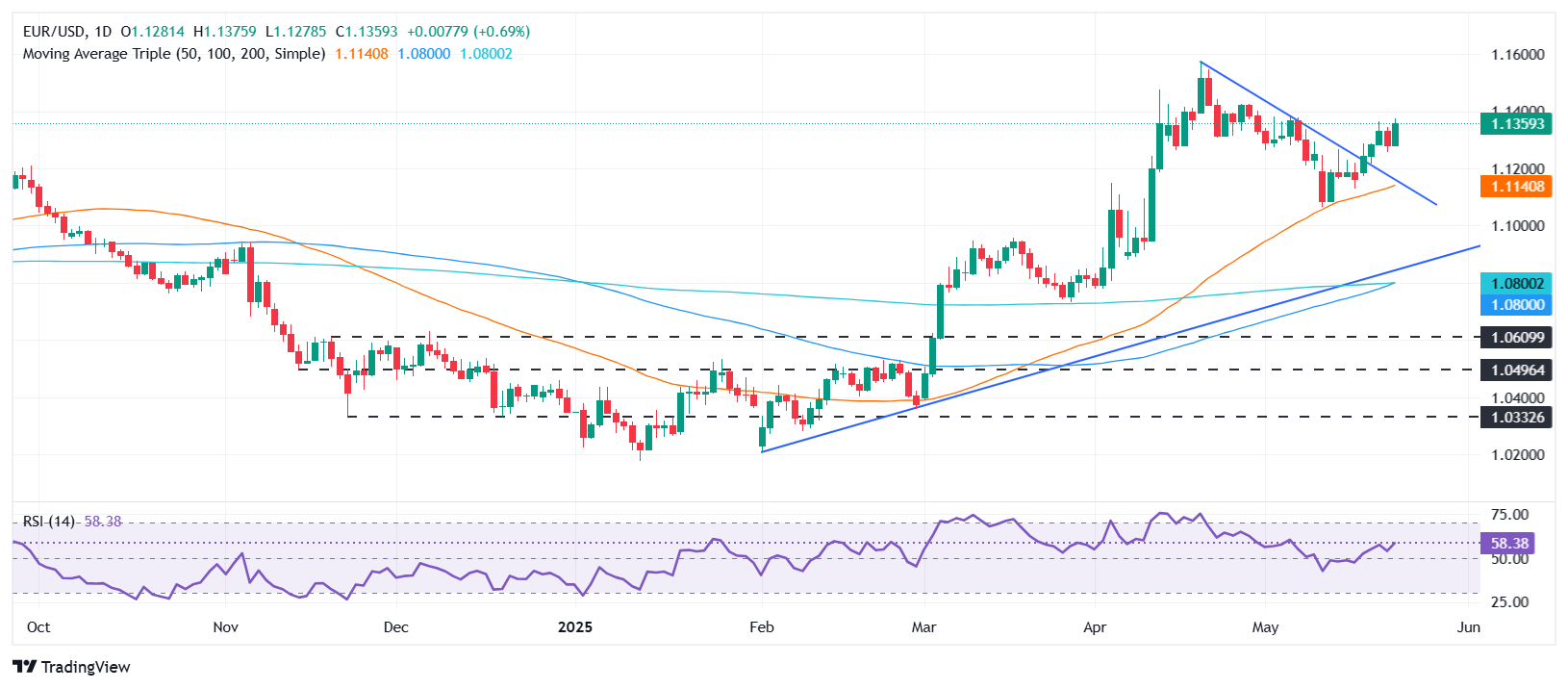
Technical expectations EUR/USD: It was appointed to Challenge 1.1400 in the short term
The EUR/USD trend resumed on Friday, as the couple reached the highest level per week at 1.1375 as a jihadist for merchants to challenge 1.1400. Buyers collect steam as the husband recorded the highest and low level during the past five days, and this is more confirming in the RSI index (RSI), which is heading before he wanders in his run.
If EUR/USD 1.1400 is scanned, it paves the way to test the key resistance levels, such as 1.1450, followed by a mark 1.1500 and a general height (YTD) at 1.1573.
On the contrary, if EUR/USD decreases to less than 1.1300, the husband can test the lowest level on May 22 at 1.1255, before 1.1200.
Common questions about the European Central Bank
The European Central Bank (ECB) in Frankfurt, Germany, is the backup bank. The European Central Bank places interest rates and runs the region’s monetary policy. The state of the European Central Bank is to maintain price stability, which means maintaining inflation by approximately 2 %. Its primary performance is by raising or lowering interest rates. Relatively high interest rates usually lead to the most powerful euro and vice versa. The Board of Directors of the European Central Bank is making monetary policy decisions at eight times a year. Decisions are made by the heads of national banks in the eurozone and six permanent members, including the President of the European Central Bank, Christine Lagarde.
In maximum situations, the European Central Bank can enact a policy tool called quantitative mitigation. QE is the process that the European Central Bank prints and uses to buy assets – usually government or companies – from banks and other financial institutions. QE usually leads to the weakest euro. Ken is the last resort when it is unlikely to achieve interest rates simply the goal of stabilizing prices. The European Central Bank used it during the great financial crisis in 2009-11, in 2015 when inflation remained stubborn, as well as during the roaming epidemic.
The quantitative tightening (QT) is the opposite of QE. It is implemented after QE when the economic recovery is ongoing and inflation begins to rise. While in QE, the European Central Bank (ECB) purchases government bonds and companies from financial institutions to provide them with liquidity, in QT, the European Central Bank stops buying more bonds, and stops investing the manager on the bonds that he already holds. It is usually positive (or bullish) for the euro.


