

[ad_1]
- The British pound succumbs to gains against the US dollar, as the British currency was less than performance.
- US President Trump increased the mutual tariff for China to 104 % against Beijing’s revenge.
- Deutsche Bank expects that BOE will reduce interest rates by 50 basis points in May.
The pound (GBP) falls against its main peers on Wednesday. The British currency faces sharp sale such as The Bank of England (FPC) has warned that the main shift in global trading arrangements may harm “financial stability by pressure on growth”.
The imposition of protectionist policies by the President of the United States (the United States) Trump has arisen from the risks of global recession. JPMorgan analysts believe that the rapid escalation of the American customs tariff for China is annoying enough to push the global economy to recession.
China is known as the world’s manufacturing center, given its competitive advantage in the cost of employment and supportive government policies. Participants in the financial market are concerned that Chinese companies will search for other markets to sell their products if their trade war with the United States is more brewing. Such a scenario will be uncommon for the UK’s economy (UK) because it seems unable to fight price war against China.
At the same time, the merchants were raised Bi Dovish Bets amid fears that the TROMP tariff policy can send a shock through the UK economy. Deutsche Bank analysts expect that the Bank of England will consider a “more powerful” response to the current economic conditions and provide a greater reduction than the interest rate than usual than 50 basis points (BPS) at the May Politics meeting. The central bank has set a significant decrease in the scanning activity IndicatorsTightening unjustified financial conditions, and fears of the slowdown in the labor market as major reasons behind the high decision of England.
This week, investors will focus on the monthly GDP (GDP) and factory data for February, which will be released on Friday. The British economy is expected to grow 0.1 % after contracting at a similar pace in January.
British pound price today
The table below shows the percentage of change in the British pound (GBP) against the main currencies listed today. The British pound was the strongest against the US dollar.
| US dollar | euro | GBP | JPY | CAD | Aud | Nzd | Chf | |
|---|---|---|---|---|---|---|---|---|
| US dollar | -0.82 % | 0.02 % | -0.99 % | -0.72 % | -1.27 % | -67 % | -1.09 % | |
| euro | 0.82 % | 0.84 % | -16 % | 0.07 % | -0.41 % | 0.14 % | -0.29 % | |
| GBP | -02 % | -0.84 % | -1.02 % | -0.74 % | -1.25 % | -69 % | -1.12 % | |
| JPY | 0.99 % | 0.16 % | 1.02 % | 0.23 % | -0.24 % | 0.30 % | -0.14 % | |
| CAD | 0.72 % | -07 % | 0.74 % | -0.23 % | -0.39 % | 0.06 % | -37 % | |
| Aud | 1.27 % | 0.41 % | 1.25 % | 0.24 % | 0.39 % | 0.56 % | 0.11 % | |
| Nzd | 0.67 % | -0.14 % | 0.69 % | -0.30 % | -06 % | -56 % | -0.44 % | |
| Chf | 1.09 % | 0.29 % | 1.12 % | 0.14 % | 0.37 % | -11 % | 0.44 % |
The heat map shows the percentage changes in the main currencies against each other. The basic currency is chosen from the left column, while the quotation currency is chosen from the top row. For example, if you choose the British pound from the left column and move along the horizontal line to the US dollar, the percentage offered in the box will represent the GBP (Base)/USD (quotation).
Daily Digest Market Movers: Bound Sterling Surrenders against the US dollar
- The British pound gives up its gains inside the day and turns into approximately 1.2765 against the US dollar (the US dollar) in the North American session on Wednesday. the GBP/USD pair He declined despite the fact that the US dollar faces pressure amid expectations that the United States can enter into this year’s recession. the US dollar index (DXY), which tracks the value of Greenback for six main currencies, drops to approximately 102.00.
- A new escalation in the trade war between the United States and China led to the dangers of recession in the United States. During the European trading session, China announced additional definitions of 50 % on the United States compared to the 34 % imposed last week, and all of them will be in effect since April 10. China has slapped the duties of huge imports on the United States to match the mutual tariff by President Donald Trump on Tuesday. Trump raised the mutual drawings on Beijing to revenge and manipulate the currency to make up for the impact of high duties.
- In addition, acceleration Federal Reserve (FED) Duofish’s stakes due to the increased risk of American recession have also been affected by the US dollar. According to the CME Fedwatch tool, traders make sure that the central bank will reduce interest rates at the June meeting.
- For more references on monetary policy ExpectationsInvestors will focus on the minutes of the Federal Open Market Committee (FOMC) from the March Policy meeting, which will be published at 18:00 GMT. At the policy meeting, the Federal Reserve has left fixed interest rates in the range of 4.25 % -4.50 %, and officials collectively maintain their instructions for interest rate discounts this year.
- This week, investors will also focus on the United States Consumer price index (Mars), which will be released on Thursday.
Technical Analysis: The British pound is still less than 20 days from EMA
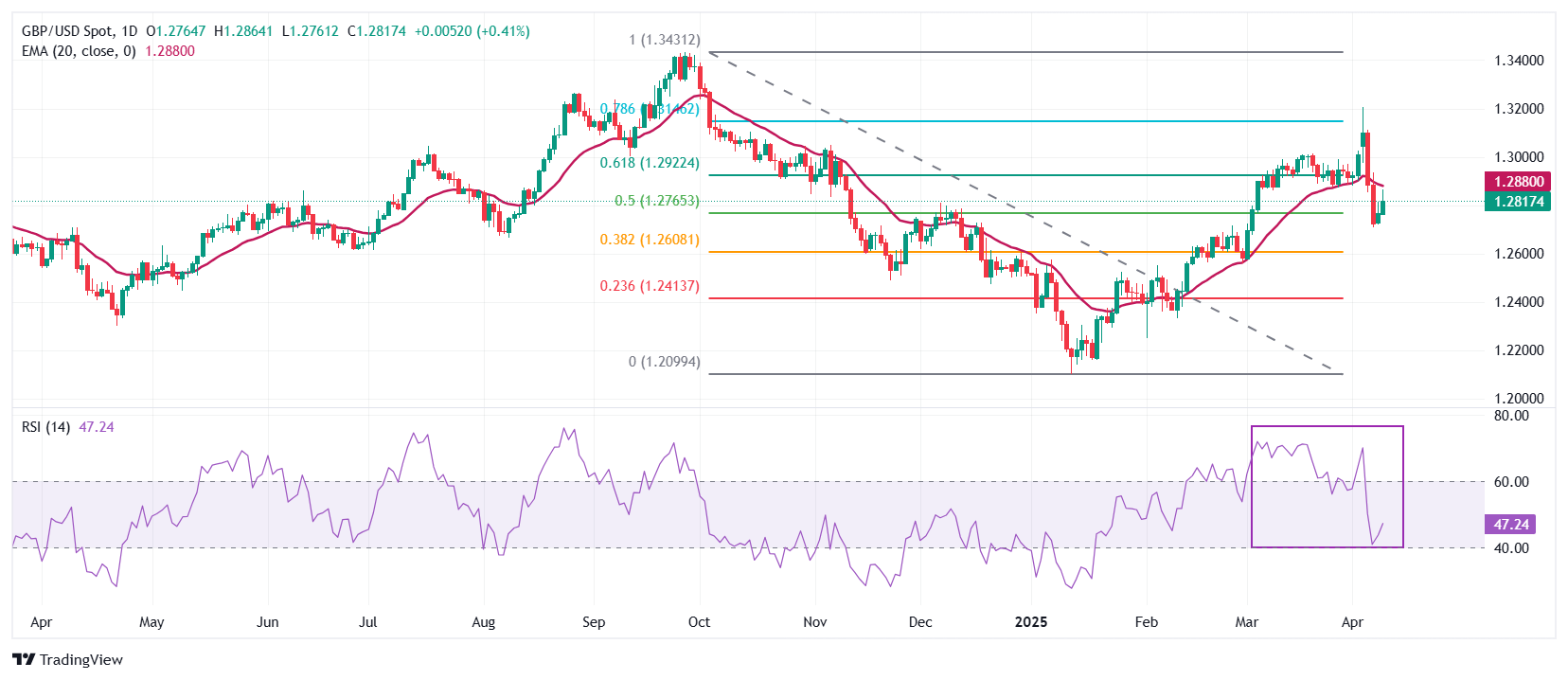
The British pound will decline to approximately 1.2765 against the US dollar on Wednesday. The expectations close to the pair are declining as the SIA moving average is traded for 20 days (EMA), which trades about 1.2877.
The relative strength index rises for 14 days (RSI) after it decreases to 40.00. Fresh downward momentum can be turned on if the relative strength index fails to keep at a level of 40.00.
Look down, 38.2 % Fibonacci The decline drawn from late September to mid -January near 1.2610 will serve as a major support zone for the husband. On the upper side, the psychological number of 1.3000 will be a major resistance area.
((This story was corrected at 10:07 GMT to say that the FOOC Open Market Committee (FOC) will be published at the March Policy meeting at 18:00 GMT, not 19:00 GMT.))
Common questions between the United States of China for war
In general, the trade war is an economic conflict between the two countries or more due to severe protectionism at one party. It involves the creation of commercial barriers, such as customs tariffs, which lead to anti -import barriers, and to import costs, and thus the cost of living.
The economic conflict between the United States (the United States) and China began in early 2018, when President Donald Trump laid commercial barriers on China, claiming unfair commercial practices and theft of intellectual property from the Asian giant. China has taken retaliatory measures and imposed a tariff on multiple American goods, such as cars and soybeans. Tensions escalated until the two countries signed the commercial deal for the first stage of the United States of China in January 2020. The agreement requires structural reforms and other changes on the economic and commercial system in China and demonstrated by restoring stability and confidence between the two countries. However, the Koronavus virus’s pandemic took the focus from the conflict. However, it should be noted that President Joe Biden, who took office after Trump, maintained the customs tariff in his place and added some additional fees.
Donald Trump’s return to the White House as an American president ignited 47 new waves of tensions between the two countries. During the 2024 election campaign, Trump pledged to impose 60 % of the customs tariff on China once he returns to his position, which he did on January 20, 2025. With the emergence of Trump, the American trade war and China aim to resume the place where it was left, with policies for corrections that affect global economic records in nutrition in nutrition.


