

[ad_1]
J.J. Adams: Don’t want to hear about politics? Then don’t follow sports. Because real life pervades everything — including your local pro sports teams and the writers that cover them.
Article content
There are days when you know the chime from your Outlook doesn’t herald the arrival of yet another numerous yet innocuous schedule update, Zoom meeting notification or yet another AI spam pitch generated by an artificially personable PR pitchbot.
Advertisement 2

Article content
Article content
Article content
No, these pings, you would swear these ones sound angrier, more outraged.
And when the dings begin to increase in frequency, like hail on a tin roof, you know a button has been pushed. The bell is most certainly tolling for thee.
Writing about the Vancouver Canucks will do it, with either side of its diametrical fan base taking umbrage over, well, just about anything. Profess an opinion about how the Flying V jersey is superior to the Skate and, well, RIP to your mentions.
But if there’s a red line the meek shouldn’t stray over as a sports writer, a Rubicon not to be crossed, it’s politics. One solitary joke line poking fun by comparing orange peels with president’s complexions will result in paragraphs of ALL CAPS SHOUTING PROFANITY.
Advertisement 3
Article content
I had a conversation with a friend recently, who regrettably confessed he had to unfollow his favourite writer because he shared a series of political posts on social media on the day that the U.S. tariffs dropped (again). His sentiment, while not quite as graceless or Laura Ingraham-esque, boiled down to: “Shut up and write.” Politics has no place in the sports pages.
“I understand wanting sports to exist in a different universe, because it’s nicer, it’s cleaner, it’s easier. I totally get that,” said Vancouver native and Toronto Star columnist Bruce Arthur, who probably claims top spot in the Canadian rankings of ‘most politically polarizing sports writers on social media.’
“But also, sports does exist in the wider world. And as time has gone on, that’s become a more unavoidable collision and meshing than ever before. It’s a more complex world, and it’s a world in which culture war eats everything.

Canucks Report
Article content
Advertisement 4
Article content
“And that means that when the president of the United States is going after the NFL for allowing players to kneel, when the president of the United States is going after LeBron James for saying that cops shouldn’t shoot Black people … this stuff matters.
“If you want to be apart from politics, I get it. I want to be apart from politics. If I could go back to just writing about sports … man, that’d be so easy and lovely. It’d be so much fun.
“But right now, here’s the bigger part of that: Even though I understand the desire to turn off that channel, that channel is coming for all of us, whether we like it or not.”
It’s unavoidable. The people booing the Star Spangled Banner at the Vancouver Whitecaps’ game last Sunday weren’t sports writers nor athletes, and neither were those who waved Ukrainian flags. Those were fans at the intersection of sports and political opinion.
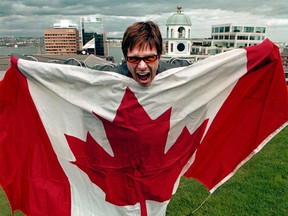
Writing about Jeff Douglas, the actor in the iconic Molson ‘I Am Canadian’ commercial last month elicited the usual amount of angry emails, as it was another story that sat in the grey area between sports and affairs of state. The story detailed the rise of Canadian pride and nationalism in the face of American economic aggression through the lens of pop culture.
That surge of patriotism also prompted Douglas and creative director Glen Hunt to reprise the ad for a contemporary time: ‘We Are Canadian (And Not the 51st State).’
Advertisement 5
Article content

We apologize, but this video has failed to load.
“It was produced by an anonymous collective of Canadian creatives and advertising professionals. Everyone donated their time, resources, experience and skill set,” Douglas wrote Wednesday.
“These are professionals who typically are competitors, coming together, offering what they have, for a common goal. It’s been a very humbling thing to witness and be part of, and … a good example of what we need to see across the country in the months ahead. No logos, no brands … the client for this one is Canada. We humbly hope it may be something that can help boost Canadian spirits.”
As we struggle with absorbing the firehose of news, and the whipsawing tariffs and rhetoric that inundates our feeds, the tone most certainly will turn more antagonistic in the coming months, especially when the inevitable economic haymakers begin to land.
Advertisement 6
Article content
Where will it lead? Well, there’s also a non-zero chance that U.S. troops could cross the border, for example, if Ontario Premier Doug Ford turns off the power taps to the States and it’s received badly by the American administration. The past five months have shown that nothing is out of the realm of possibility.
Arthur was in Sochi for the 2014 Olympics when Russia first sent troops into Crimea, and watched his Ukrainian counterparts’ demeanour change as it quickly grew into a full-fledged invasion just a few days after the Games concluded.
We’re cursed to live in interesting times, he chuckled grimly.
“There probably hasn’t been a better time in the last 80 years to have a history degree,” he said. “The politics right now is not the politics that you or I grew up with. It’s closer to the politics that our grandparents and great-grandparents grew up with. It’s changed.
Advertisement 7
Article content
“And right now is a time where not only do you have to choose sides more than ever before — and that isn’t necessarily right or left; it’s Canada/United States, it’s democracy/not democracy — but politics is coming for all of us. It is going to affect all of our lives in so many different ways than we ever imagined it would.
“I don’t know what’s going to happen between now and 2028 … It’s possible that when we march into L.A. in 2028 for the Olympics, all the countries from all around the world, we’ll be walking into an Olympics that isn’t that dissimilar from 1936 in Berlin. It’s on the table, is what I’m saying. The world is changing faster than most of our brains can keep up with.”
The world has changed too fast for some.
The recent women’s PacWest basketball championship saw Vancouver Island University take home the gold and earn a trip to the CCAA Nationals next week in New Brunswick. The Mariners have a transgender player — Harriette Mackenzie — who’s been embroiled in a chaotic slew of news stories and attention, questioning her right to play.
Advertisement 8
Article content
Columbia Bible College was set to host the provincial tournament, but their conduct in a game against VIU sparked an inquest that cost them the tournament and saw coach Taylor Claggett suspended.
Mackenzie’s MVP performance in the championship game — 21 points, 10 rebounds — will no doubt see the 6-foot-2 forward painted as a manly brute with an unfair biological advantage instead of the truth: a graceful, skilled player with exceptional footwork who can barely do a pushup.
Arthur has a story coming out on Mackenzie in the coming days that delves, 4,000 words deep, into the sensitive topic, with the goal of bringing nuance and understanding to the issue. He writes about the need for bag checks and metal detectors for Mackenzie’s games, the shouts of “tranny whore” from the Columbia men’s players who watched the game from floor seats across from the Mariners’ bench and how Mackenzie rose above it all.
Advertisement 9
Article content
And he’s ready for all those Outlook notifications that will drop immediately after his story’s publication.
“I think this will kick the hornets’ nest again,” Arthur said. “What you hope is that you convince the people who can be convinced. One of the points I try to make in the piece, one of the key things that happened here, is ally-ship. People stood with this kid and tried to help her. From the coach to the people to the 30 organizations that sent people to the games to support her. Her teammates all stood with her.”
It will be polarizing and political. It will outrage some. It will educate others. And it’s necessary.
“We live in history now in a way that we didn’t before,” he said. “So that both makes the role of sports as a stand-alone thing more important … and more impossible.”
Recommended from Editorial
-

Famous ‘I Am Canadian’ Molson beer ad resonates 25 years later amid tariff uncertainty
-

Canucks vs. Ducks Game Day Update: Quinn Hughes won’t shrug off pain to play tonight


Article content


