

[ad_1]
New research has also shown that domestication of cats and dogs is more diverse, but also both – with serious effects on their health and well -being.
At first glance, cats and Persian cats do not seem as if they had a lot of common denominators. One cat, the other dog, separates 50 million years of development. But when the evolutionary biologist Abe Grace Drake and her colleagues 1,810 skulls From cats, dogs and wild relatives, they found something strange. Despite its remote history, many cats and dogs show amazing similarities in the shape of the skull.
In evolutionary biology, the difference is a common process. In simple phrases, Disagreement It is the place where they become a nickname to share an increasingly different common origin over time, while Rapprochement It means becoming more similar. With groups of animals divide and adapting to different environments, they gradually develop new features, a process known as Different development.
This is one of the main methods that make up the new species different features, causing the population to develop along separate paths. But sometimes, development can take a different direction. Convergence occurs When the non -relevant species, which are formed by similar pressure, are independently evolving similar features.
In the case of home cats and dogs and Many other domesticated typesIt seems that the deliberate and unintended selection by humans has created rapprochement, and directs the different types by mistake towards similar features.
Despite a long history of The evolutionary chapterBlacks with a flat face such as the Persian cat and the logs share similar skull structures.
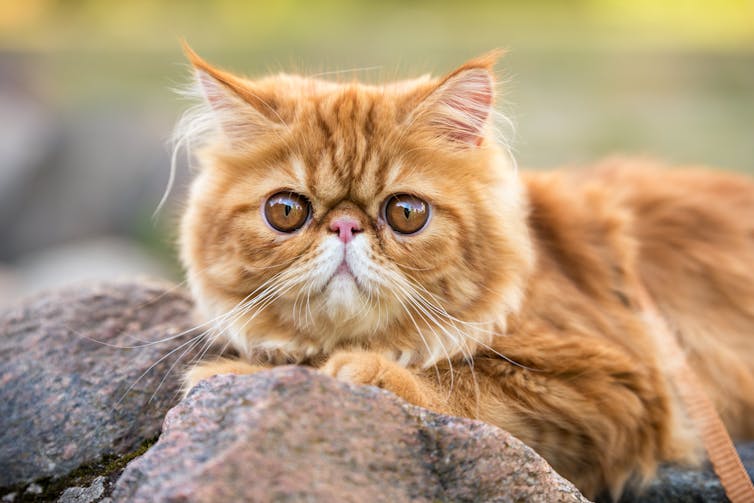
Zanna Pesnina/Shutterstock
To investigate the extent that the skull structure has settled it, Drake and its colleagues analyzed the 3D scanning operations of the museum samples, veterinary schools and digital archives. Their data collection included home cats such as Siamese and Maine CON and Persian breeds, as well as more than 100 strains of dogs from short dogs such as clay, to long breeds like Collies.
The results they reached showed that the domestication did not increase the diversity of the shape of the skull only to the wolves and wild drops, but also led some cats and dogs to resemble each other, with a rapprochement towards long or flat faces. The wild canids (the group of animals that include dogs, wolves, foxes, and insults) tends to share a similar outstretched skull, while wild Felids (the group of animals that include home cats, black, tigers, jaguars) show more natural contrast.
However, the local strains of both types now extend to a more extreme range in both ends of the scale. This trend can be seen in the appearance of jam cats to resemble the XL pioneer dogs.
The domestication has long been shown that when humans interfere, even the relevant species The search can endSometimes it suffers, in similar ways.
His selective education Excessive features across species. Many other changes that man -made can push animals beyond what their bodies can support naturally. For example, some chicken carries its meat, 30 % of body weight, in the breast muscles, often leads to heart and lung problems.
Human preference for a flat -faced pet in some of our basic instincts. Human beings Hard to respond To infant features such as roundheads, small noses and low eyes. These features, which are exaggerated in many strains of cats and dogs with a flat face, mimic the appearance of human children.
Of all species, humans Among the most fibersThis means that we are born impotent and rely on caregivers to survive, which is a feature that we share with puppies and cats. in contrast, Pre -animals They are able to See, listen, stand and move Shortly after birth. Since human infants are highly dependent on adult care, we have formed Evolution to be sensitive to weaknesses and need.
These signals are like round cheeks and wide eyes of children, known as Social recovery operations. It leads to the behavior of providing care for adults, from Speak in high colors To provide parental care.
Herred gulls (A type of seag) is an example of this in non -human animals. Their suspicion is instinctive in a red spot on the parent’s beak, which leads to adults renewing food. This red spot acts as a social restoration, ensuring the needs of the chick in a timely manner. Similarly, the domesticated animals have effectively they have Kidnapping of old care It evolved for our offspring.
These traits may give pets an advantage in seeking human care and attention, but it comes at a cost.
UK government commissions are their animal care committee to advise independent experts regarding the concerns of emerging animal care. In the reports it produced in 2024, the committee raised great concerns about the influence of selective education in both Cats and Dogs.
Reports highlighted that reproduction of extremist physical features, such as flat faces and exaggerated skull shapes, led to widespread health problems, including breathing difficulties, neurological conditions and birth complications.
The committee argues that animals that suffer from severe genetic health problems should not be used to reproduce, and call for a tougher regulation of educators. Without these reforms, many popular strains will continue to suffer from preventive conditions that limit life.
Selective education has shown how easy the nature bends naturally for their preferences, and how millions of years of evolutionary separation can be exceeded by a few contracts of artificial choice.
In the choice of pets that mimic the faces of infants, we have, often unintentionally, for animal features. Understanding the forces that drive the rapprochement between species is a reminder that we play a strong and sometimes dangerous role in its formation.


