
Raymond J. de Souza: Tendency towards enhanced executive power on rise in U.S. and Canada


[ad_1]
The potential for grift, unintentional or otherwise, is one that should not be overlooked
Article content
Executive power to arbitrarily set tariffs, like all executive power, tends to corrupt.
It gives the tariff-maker the power, even on a whim, to impose great financial pain on significant actors who, in turn, have a keen interest in attempting to influence the exercise of that power. How those attempts play out bears careful watching.
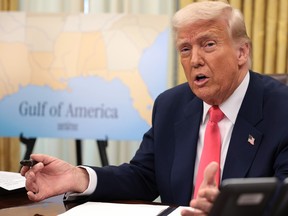
When President Donald Trump announced his tariffs on Canada and Mexico, the leading executives of Ford, General Motors and Stellantis were quickly on a conference call with the president. He gave them a temporary reprieve. Mothers facing higher costs for Mexican produce in the supermarket don’t get to phone the president. Arbitrary power favours the rich.
Advertisement 2

Article content
Enhanced executive power is attractive to executives. It permits Trump to ignore the free trade agreement — his own agreement — with Canada and Mexico. It permits Prime Minister Mark Carney to effectively abolish — by setting the rate to zero — the consumer carbon tax without having to amend the law in Parliament. It is why British Columbia Premier David Eby is proposing a law that would give him the power to make laws without approval by the legislature.
Monied interests always seek to influence policymakers. That’s why there exists a vast lobbying industry, once-upon-a-time known as “influence peddling” but, after significant regulation, now more benignly called “government relations.”
Soon after Trump began his tariff aggression, Canada’s premiers hired a Washington lobbying firm at C$120,000 per month. Which firm to choose when there are so many? The premiers chose Checkmate Government Relations, perhaps a surprising choice in that it only opened its Washington office in December. How did they so quickly land an annual contract worth nearly $1.5 million?

Platformed
Article content
Advertisement 3
Article content
Yukon Premier Ranj Pillai called up Donald Trump Jr., whom he had met once before. The president’s son invited Pillai to a get-together of friends in North Carolina. Donald Jr. told Pillai that he did not speak for his father’s administration but, to the premier’s astonishing good luck, also in the room was Charles F. McDowell IV, a hunting buddy of Donald Jr.. He owns Checkmate and opened his Washington office just weeks after the election. His brother is a congressman. Checkmate also employs Chris LaCivita Jr., the son of the Trump campaign’s co-chair.
It is debated what long term effects Trump’s tariff policy will have, but one short term result is clear. Canada’s provinces are putting north of a million dollars into the pockets of Donald Jr.’s friends.
When billions of dollars are at stake, it makes good sense to grease the wheels, does it not?
That is why the premiers collectively hired Checkmate. Individually, the various provinces also lavished public money on their own lobbyists. The wheels need for grease is near infinite.
In wholly unrelated news, Vice President JD Vance was appointed on Monday as finance chairman of the Republican National Committee, responsible for raising hundreds of millions for Republican campaigns in the 2026 midterm elections. No sitting vice president has ever had that role, on the grounds that he ought to be fully occupied with his day job, that it is unbecoming for a vice president to serve as chief party bagman, and that there should be a minimal attempt to put distance between those soliciting donations and those executing policy.
Advertisement 4
Article content
For quite some time, those attempts have been extremely minimal on a bipartisan basis. Trump himself has set aside even the pretense, selling dinners at Mar-a-Lago for $1 million a plate; $5 million gets you a meeting with the president.
It may well be that Vance has no intention of peddling influence — or at least no more of an intention than anyone else in what he derides as the “Washington swamp.” Yet donors might think differently. What happens when the RNC calls up the heads of Ford, GM and Stellantis, asking them to meet with Vance to discuss donating to the Republican Party?
A few million to the RNC for a grateful vice president is only a more naked example of the wider phenomenon. To hold power has always been lucrative for those willing to sell their influence on the market.
Hence the special attraction of arbitrary tariffs, announced in the morning, suspended in the afternoon, threatened again in a midnight tweet. Trump boasts of the power tariffs give him over foreign governments, whether in Columbia or Canada. Trump had the premiers cap-in-hand at the White House, with them paying his son’s friends to facilitate the privilege of doing so.
President Trump has offered an accommodating array of motives for tariffs, adaptable to mood and circumstance, from regional security to fentanyl to defense spending to cartography to cheese exports. The enhancement of executive power and its potential for grift, unintentional or otherwise, is one that should not be overlooked.
National Post
Recommended from Editorial
-

B.C. legislation would give cabinet sweeping powers amid U.S. tariff threats
-

FIRST READING: The ‘fake’ document at Carney’s Trump-style signing ceremony
Article content


